

 Merchant Login
9 September, 2026
Altron FinTech Household Resilience Index performs well during the first quarter of 2026, but flags the urgent need for formal sector job creation
Background to the AFHRI
In recognising the need for data that provides more clarity on the financial disposition of households in general, and their ability to cope with debt in particular, Altron FinTech commissioned economist and economic advisor to the Optimum Investment Group, Dr Roelof Botha, to assist in designing this index. The index comprises 20 different indicators, all of which are directly or indirectly related to sources of income or asset values. The AFHRI is weighted according to the demand side of the short-term lending industry and calculated every quarter, with the first quarter of 2014 being the base period, equalling an index value of 100. All the indicators are expressed in real terms, i.e., after adjustment for inflation.
Media Release
Johannesburg, 9 September 2026 – The results of the Altron FinTech Household Resilience Index (AFHRI) for the first quarter of 2026 were released today. The index recorded its seventh successive increase in the seasonally adjusted value, which was 115.8 and, by definition, 15.8% higher in real terms than the base period of 2014 (first quarter). Compared to the fourth quarter of 2025, the seasonally adjusted reading of the AFHRI was less than one percent, mainly due to declines in a number of indicators that carry a large weighting in the composite index, namely private sector employment, private sector salaries and household consumption expenditure. The latest reading translates into a decline in household financial resilience in per capita terms.
Increase in disposable income
The seasonally adjusted year-on-year reading was higher at 2.4% in real terms, confirming some relief for households during the first quarter of 2026. This was driven mainly by lower interest rates, which has led to a year-on-year increase of 5.9% in the ratio of household income to debt costs and supported a 2.6% increase in real household consumption expenditure and a 1.1% increase in real household disposable income.
Figure 1 illustrates the sharp decline in the AFHRI during the lockdown period in 2020, which was followed by a swift and pronounced recovery, fuelled by the lowering of the prime rate to 7%. Unfortunately, the oil price shock that accompanied Russia’s military invasion of Ukraine predictably led to an increase in both the consumer price index (CPI) and the producer price index (PPI). When the CPI rose to above the upper level of its previous target range (6%), the MPC continued to hike the country’s short-term benchmark lending rate, which ultimately resulted in an increase in the nominal cost of credit and of capital of 68%.
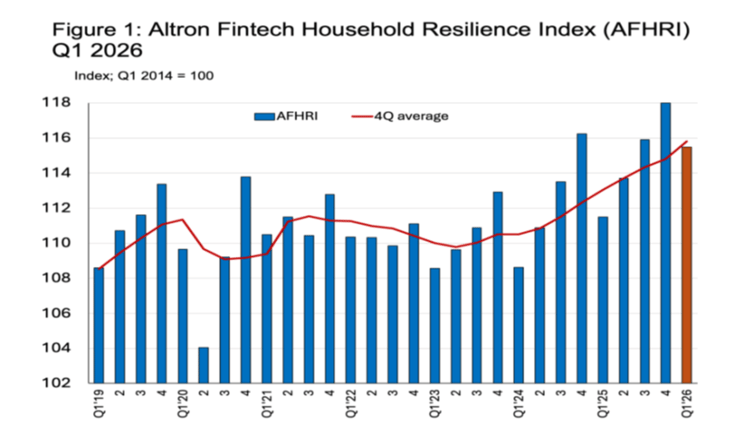
It was predictable that the AFHRI would take a knock as a result of the excessively strict monetary policy of 2023 and 2024. It was also predictable that lower rates, which commenced at the end of the third quarter of 2024, would lead to an increase in the financial resilience of households, as illustrated by figure 1.
Property market recovery under threat
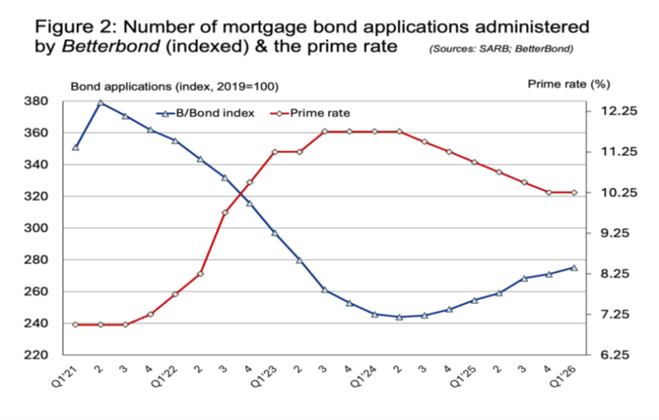
Although the AFHRI has recovered from the worst of the debilitating effects of the interest rate hiking cycle of the monetary policy authorities between 2023 and 2024, the resumption of restrictive monetary policy poses a threat to the financial resilience of households, in general, and the residential property market, in particular. It is clear from the trends in figure 2 that an inverse relationship exists between the number of applications for mortgage loans by prospective home buyers and the prime lending rate.
The BetterBond index of home loan applications suffered the same fate as the AFHRI during the rate hiking cycle of the Monetary Policy Committee (MPC) of the Reserve Bank and also recovered once the prime rate had declined again. However, this recovery is not complete, as also witnessed by the value of residential building plans passed by the country’s larger municipalities and metros, which remains siginifacntly lower than before the restrictive monetary policy of 2023 and 2024.
Household finances lagging GDP
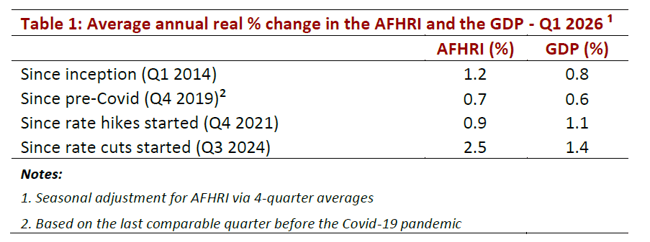
Assessed against the last comparable quarter before the COVID-19 pandemic (Q4 2019), the financial disposition of South African households has improved at an average annual real rate of merely 0.7%, which is marginally higher than the average annual real rate of GDP growth over the past six years (0.6%). The data sets in table 1 confirm the damaging effects of the rate-hiking cycle on the financial resilience of households, with the average annual real rate of change in the AFHRI lagging behind that of the GDP, albeit marginally. The positive impact of lower interest rates on household finances is clearly reflected in the superior performance of the AFHRI since the end of 2021 (compared to GDP).
More rate-cutting required
Within four months of the strange decision by the MPC to replace the previous inflation target range of 3% to 6% with a target point of 3%, it has come back to haunt the economy. Empirical economic research has confirmed that the inflationary effects of an oil price shock is significantly more severe for emerging markets than for advanced economies.
South Africa is an emerging market that is geographically far removed from the lucrative production and consumer markets of the advanced economies, which means that transport costs will always be highly susceptible to higher oil and fuel prices. Since the war in Iran broke out at the end of February, higher oil prices was always on the cards. South Africa’s CPI promptly broke through both the new target point and the tolerance level of 4%, with the MPC reacting by raising the prime rate to 10.5% (via the repo rate).
Fortunately, common sense has since prevailed and rates have not increased again. Against the background of the inability of higher interest rates to contain inflation that is induced by the supply-side of the economic equation, it is advisable to resume the rate-cutting cycle post haste. The South African economy has been battling to lift its GDP growth rate to more than one percent and continues to lag most of its peers within the emerging markets. Higher economic growth and employment creation are desperately needed and lowering the cost of credit and of capital will incentivise higher levels of demand.
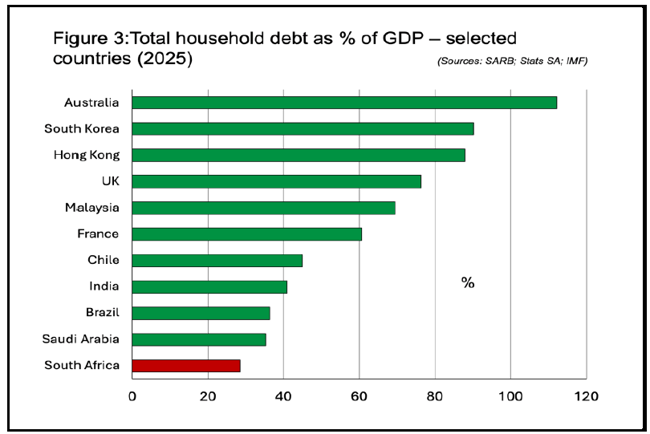
The need for further interest rate cuts is underscored by the fact that South Africa’s household debt/GDP ratio is amongst the lowest in the world, as illustrated by figure 3.
Results of the AFHRI for the fourth quarter of 2025
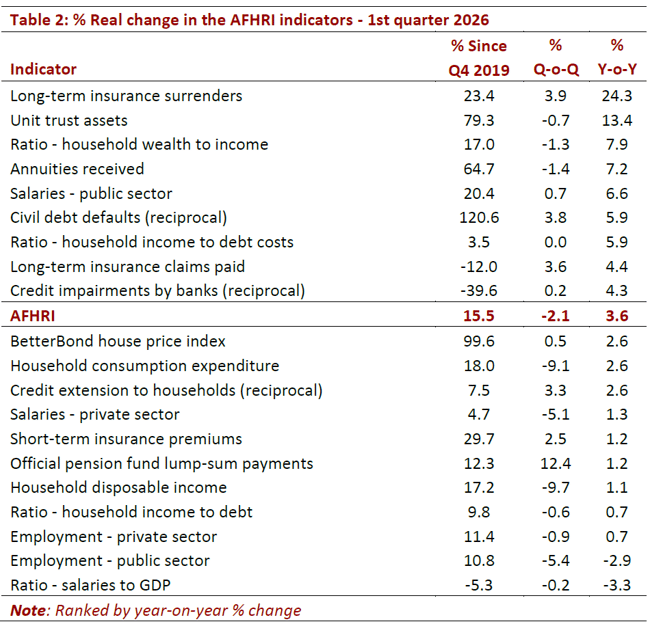
Table 2 summarises the performance of the different indicators comprising the AFHRI over three different periods, i.e. since the last comparable quarter before the COVID-19 lockdowns – Q4 2019; quarter-on-quarter; and year-on-year (percentage changes in real terms). The period since the fourth quarter of 2019 is regarded as relevant to gauge whether or not the financial resilience of households has fully recovered from the pandemic.
An impressive improvement of the AFHRI was recorded during the first quarter of 2026, with the latest reading of 115.5 having improved year-on-year by 3.6%. Since its inception in 2014, the AFHRI was hit hard on two occasions – firstly by the lockdowns imposed by the health pandemic in 2020 and again by the record high interest rates of 2023 and 2024, when the prime overdraft rate went to 11.75%, despite the absence of demand inflation.
Ever since the welcome start of a rate-cutting cycle by the Monetary Policy Committee (MPC) of the Reserve Bank, households and businesses alike received financial breathing space via the lower cost of credit and of capital. Without meaningful growth in household consumption expenditure and investment in the assets required for expanding production, an economy will battle to improve the standard of living of its citizens.
One of the reasons for the sharp year-on-year increase in surrenders of life insurance is the loss of 190,000 formal sector jobs during the first quarter of 2026. Although there is a seasonal influence at play (due to the increase in employment that accompanies bumper retail and holiday spending during the fourth quarter of the preceding year) a year-on-year loss of employment was also recorded in the first quarter of 2026. For obvious reasons, the loss of a job often triggers the surrender of previous savings.
Although surrendering a life insurance policy boosts a person’s income, the short-term gain needs to be juxtaposed with a number of disadvantages. These include the loss of a long-term financial safety net, potentially higher income tax liabilities and early surrender fees, which reduces the payout.
Looking ahead to the results for the second quarter of 2026
Unfortunatey, it seems that some dark clouds have gathered on the economic horizon, especially with regard to the further escalation of fuel prices and an increase in unemployment (including discouraged work-seekers). With the manufacturing sector apparently facing a structural slump, caused, inter alia, by a massive trade deficit with China; a drop in tourist arrivals from overseas; and the construction sector treading water, the AFHRI will have to depend on other sources of stimulus if it is to maintain its upward momentum.
These could include a vibrant retail trade sector, record summer grain crops, the motor vehicle sector, mineral exports and new investments in energy and logistics infrastructure. The latter growth drivers are crucial for the quest to raise formal sector employment and remuneration levels, which represent the highest weighting in the determination of the AFHRI.
Johan Gellatly, Managing Director of Altron FinTech, says the latest data quantify how precarious the household recovery remains, despite the modest gains recorded since 2024.
"Formal sector employment fell by 190,000 in the first quarter, and that is the number driving the rest of this index. It is why life policy surrenders are up more than 24 percent year on year, and why household income and spending both went backwards in the quarter even as the annual picture improved. Households are not spending their way into difficulty, they are running out of earners. Until this economy is creating formal jobs at scale, every gain the index records is borrowed against the next shock."