

 Merchant Login
17 March, 2026
The Altron FinTech Household Resilience Index (AFHRI) receives a boost from lower interest rates in the third quarter of 2025
Background to the AFHRI
In recognising the need for data that provides more clarity on the financial disposition of households in general, and their ability to cope with debt in particular, Altron FinTech commissioned economist and economic advisor to the Optimum Investment Group, Dr. Roelof Botha, to assist in designing this index. The index comprises 20 different indicators, all of which are directly or indirectly related to sources of income or asset values. The AFHRI is weighted according to the demand side of the short-term lending industry and calculated every quarter, with the first quarter of 2014 being the base period, equalling an index value of 100. All the indicators are expressed in real terms, i.e., after adjustment for inflation.
Media Release
Johannesburg, 12 March 2026 – The results of the Altron FinTech Household Resilience Index (AFHRI) for the third quarter of 2025 were released today, indicating modest relief for South African households during 2025. The AFHRI recorded a year-on-year increase of 2.1%, supported mainly by lower interest rates, which helped ease financial pressure on households.
Although the improvement reflects a gradual recovery in household financial resilience, the average annual growth in resilience since the start of the interest rate hiking cycle remains below 1%. This suggests that, in per capita terms, the financial position of households is still deteriorating. However, the slight decline in the prime lending rate contributed positively to the index, helping it recover gradually after the impact of earlier rate hikes.
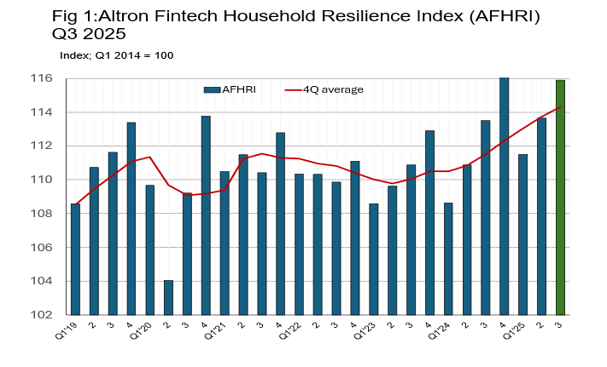
Long-Term Analysis Trend
Compared to the last pre-pandemic quarter (Q3 2019), real household resilience has increased by only 0.6% per year, slightly below the average annual real GDP growth rate of 0.7% over the same period. Since the AFHRI index launched in 2014, the AFHRI has grown 1.2% per year on average, marginally outperforming GDP. However, households have fared worse than the broader economy since interest rates began rising in 2021, as shown in Table 1. Lower rates continue to have a clear positive impact on both the AFHRI and GDP performance.

Impact of pension fund withdrawals
The introduction of the “two-pot” system in September 2024, which allows early access to a portion of a person’s retirement savings, has had a material influence on several AFHRI indicators, especially annuity receipts and insurance policy surrenders. In Q3 2025, 2025, annuities rose 9.3% year-on-year and long-term policy surrenders surged 22.5% quarter-on-quarter, abnormally high movements relative to historical norms prior to the two-pot system.
Between July and September 2025, long-term insurance surrenders totalled R95.3 billion -42% above the average for the ten quarters preceding the introduction of the “two-pot” system. Although the system provides valuable liquidity for households, withdrawals are taxed at an individual’s marginal rate, significantly exceeding the South African Revenue Service’s initial revenue projections.

The effect of lower rates
Figure 2 illustrates the strong relationship between interest rates and household resilience. When the prime rate fell 7% in mid-2020, the AFHRI rebounded from a Covid-induced low of 104.1 to 113.8 – a gain of over than 9%. Subsequent rate hikes to 15-year highs weakened household resilience, which only began recovering as rates eased again.
South Africa’s employment landscape remains constrained: formal employment now mirrors the number of unemployed individuals, at just over 11.6 million (including discouraged work-seekers). After a brief improvement in 2021-2022, unemployment rose again as interest rates were increased and GDP growth slowed to below one per cent in 2023 and 2024.
With most economists polled by Unisa’s Bureau for Market Research forecasting sub2% GDP growth for 2026, more aggressive rate cuts appear essential to reigniting growth and boosting employment.
Results of the AFHRI for the Third quarter of 2025,
An encouraging feature of the latest AFHRI is the stability that has crept in for the average index value over the past four quarters, which eliminates seasonal influences. The AFHRI’s four‑quarter average reading reached 114.3 a 0.5% quarter‑on‑quarter rise and a stronger 2.5% improvement year‑on‑year. Fourteen of the 20 index indicators improved year-on-year, and 15 strengthened quarter-on-quarter.
Other key trends include:
- Private sector employment improved, though total real salaries edged down slightly.
- Unit trust asset values posted the strongest gains, supported by the JSE All Share Index reaching an all‑time high.
- The income‑to‑debt servicing ratio improved, helped by the rate cut to 10.5% at the end of Q3.

The table summarises the performance of the different indicators comprising the AFHRI over three different periods, i.e. since the last comparable quarter before the COVID-19 lockdowns – Q3 2019; quarter-on-quarter; and year-on-year (percentage changes in real terms). The period since the first quarter of 2020 is regarded as relevant to gauge whether or not the financial resilience of households has fully recovered from the pandemic.
Looking ahead to the fourth quarter results
The combination of traditional festive-season spending, 13th cheque payments, and the November rate cut is expected to support further gains in the AFHRI for Q4 2025. Sustained improvement will, however, depend heavily on job creation.
Johan Gellatly, Altron FinTech Managing Director, said:
“The latest AFHRI results show that although financial pressure on households remains real, the gradual improvement we’re seeing is an encouraging sign that relief is beginning to take hold. Lower interest rates are starting to create space for recovery, and we expect this positive trajectory to strengthen as market conditions stabilise.
At Altron FinTech, we remain committed to equipping financial institutions and businesses with the insights, analytics and technology they need to navigate this period with confidence. Our solutions help organisations anticipate shifts in consumer behaviour, manage risk more effectively and make informed, forward‑looking decisions.”